
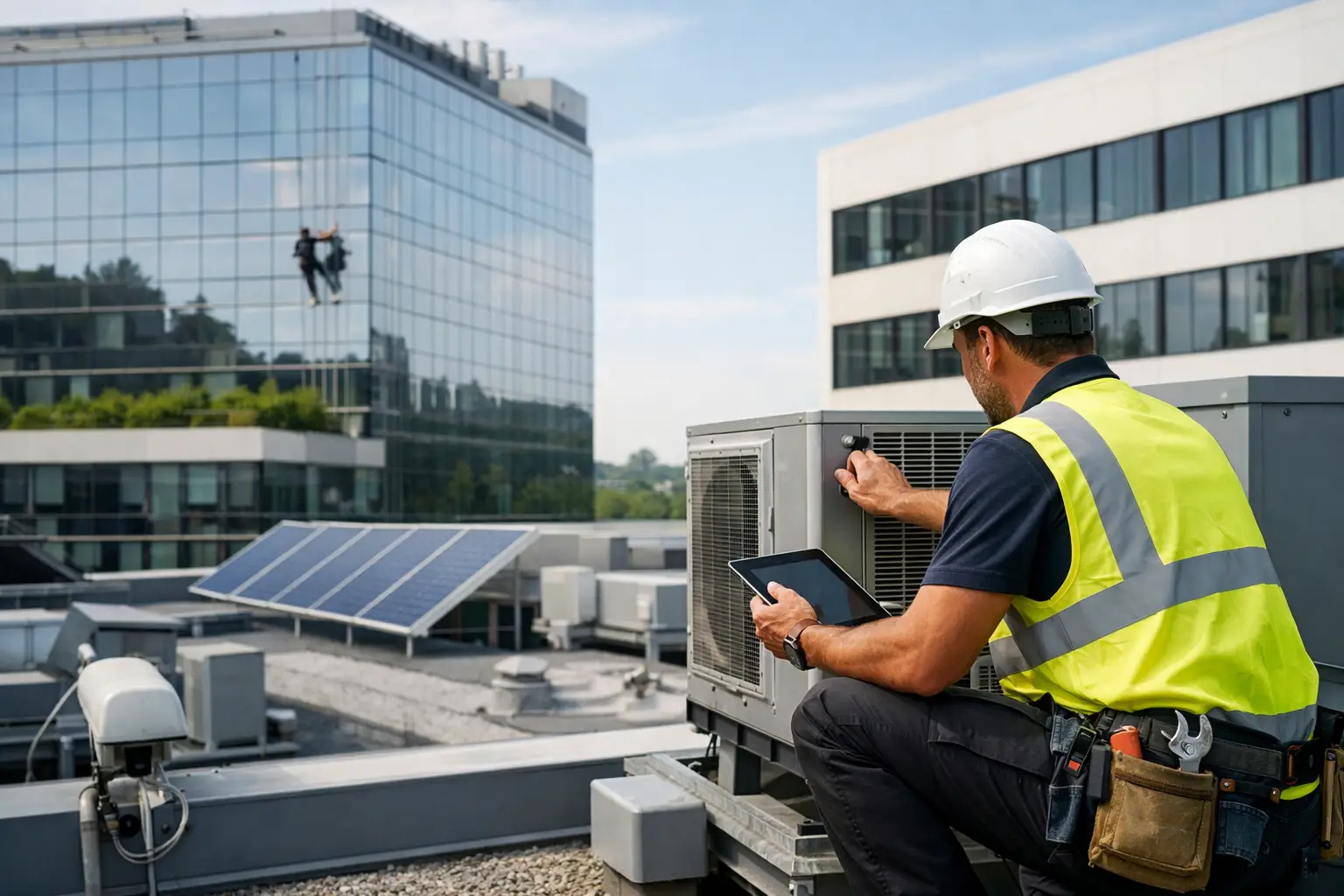
A stained ceiling tile under a rooftop unit is rarely just a ceiling-tile problem. In commercial properties, it can point to a clogged condensate drain, failed flashing, a deteriorated roof penetration, or humidity entering an unconditioned space. The most meaningful commercial building maintenance trends are moving owners away from isolated repairs and toward finding the conditions that create repeat damage.
For owners, buyers, lenders, and property managers, that shift matters. Deferred maintenance can affect tenant operations, insurance claims, loan requirements, property value, and the cost of a future renovation. In Southeast Texas, high humidity, heavy rain, hurricane exposure, expansive soils, and wood-destroying insects add another layer of risk that should not be managed with a generic maintenance checklist.
Commercial Building Maintenance Trends Affecting Owners
Preventive maintenance is replacing reactive repair
For years, many commercial maintenance budgets were driven by immediate failures: an air-conditioning unit quits cooling, a roof leak appears after a storm, or a plumbing line backs up. Reactive work is unavoidable at times, but it is typically more disruptive and more expensive than scheduled service.
Owners are increasingly tracking equipment age, service history, recurring deficiencies, and expected replacement windows. This allows them to plan for capital expenses instead of treating a predictable end-of-life failure as an emergency. A ten-year-old rooftop unit may still operate, for example, but repeated repairs, reduced efficiency, deteriorated insulation, or corroded components can indicate that replacement planning should begin before the unit fails during peak cooling season.
The trade-off is straightforward: planned maintenance requires consistent spending and recordkeeping, even when nothing appears broken. The benefit is fewer surprise closures, better budgeting, and a clearer record of how the property has been cared for.
Building envelope performance is getting closer attention
Roofing, exterior wall assemblies, windows, sealants, gutters, and drainage are receiving more scrutiny because moisture damage often begins outside the building long before it becomes visible indoors. Water intrusion can damage insulation, corrode framing or fasteners, stain finishes, promote microbial growth, and create conditions favorable to wood-destroying organisms.
This is especially relevant along the Gulf Coast and across the Golden Triangle. Wind-driven rain can bypass failing sealant joints, damaged flashing, poorly integrated roof penetrations, and deteriorated exterior cladding. Flat and low-slope roofs also need regular observation for ponding water, open seams, damaged coatings, clogged drains, and compromised penetrations around mechanical equipment.
A roof that does not leak during a brief inspection is not automatically a roof without concerns. Inspectors and maintenance teams should look for evidence of past leakage, temporary patches, interior stains, soft or deteriorated materials, and drainage conditions that can shorten roof life. The same principle applies to exterior walls: the visible surface may look acceptable while moisture is entering at transitions and penetrations.
Moisture monitoring and infrared imaging support better decisions
Maintenance teams are making greater use of tools that help identify hidden conditions before major finishes are removed. Moisture meters, infrared thermography, and targeted investigation can help locate areas that deserve further evaluation. A thermal anomaly may reveal wet insulation, air leakage, missing insulation, or an overheating electrical component.
These tools do not replace direct observation or invasive testing when needed. Infrared images show temperature differences, not a final diagnosis. A cool ceiling area could be related to moisture, but it could also be caused by air-conditioning duct leakage or a difference in insulation coverage. The useful trend is not simply using more technology. It is pairing technical tools with field experience and confirming the cause of the condition.
HVAC maintenance now includes humidity control
Cooling equipment in Southeast Texas does more than lower temperature. It also removes moisture from indoor air. When systems are oversized, poorly balanced, short-cycling, improperly drained, or operating with dirty coils and restricted airflow, humidity control can suffer even if occupants say the building feels cool.
Excess indoor humidity can contribute to condensation on supply diffusers, odors, staining, corrosion, warped finishes, and microbial growth. In offices, medical spaces, retail buildings, restaurants, and multifamily common areas, these issues can quickly become tenant complaints and operational concerns.
Routine HVAC maintenance should include more than changing filters. It should address condensate drains and pans, refrigerant line insulation, duct condition, equipment supports, electrical disconnects, coil cleanliness, roof curbs, and signs of leakage around mechanical penetrations. The exact scope depends on the building type and system design, but humidity performance should be part of the conversation.
Data Helps, but Site Conditions Still Matter
Digital maintenance platforms are becoming more common in commercial buildings. They can organize work orders, track recurring repairs, store equipment manuals, document inspections, and alert managers when routine service is due. For owners with multiple locations, this can improve accountability and prevent maintenance records from being scattered among emails, invoices, and staff turnover.
However, software cannot determine whether a crack is cosmetic, whether a roof patch is holding, or whether a staining pattern suggests an active leak. Data is only as useful as the observations entered into the system. A maintenance log that says “repaired leak” without identifying the source, affected materials, and follow-up date does little to protect the owner from repeat damage.
A practical record should document the location, condition observed, probable cause if known, repair performed, photographs, responsible contractor, and whether the repair was rechecked. That level of detail is particularly valuable during a sale, lease dispute, insurance claim, or lender review.
Energy upgrades are being evaluated as maintenance decisions
LED lighting, higher-efficiency HVAC equipment, roof coatings, insulation improvements, occupancy controls, and water-saving fixtures are often discussed as energy projects. They are also maintenance decisions. Older systems may require frequent service, use hard-to-source parts, or create operating costs that no longer make sense.
Still, not every upgrade produces the same result. Replacing equipment without correcting duct leakage, poor drainage, uncontrolled outside air, or building-envelope defects can leave the owner with a newer system and the same comfort complaints. Before spending capital, it helps to identify the actual source of the performance issue.
For a buyer considering an older commercial property, this distinction can affect negotiations. A building may be functional on the day of inspection but carry a near-term need for roof, HVAC, electrical, plumbing, or drainage work. Understanding that difference is more useful than receiving a simple pass-or-fail impression.
Local Risk Planning Is Becoming More Specific
Commercial properties in Texas should not use a one-size-fits-all maintenance schedule. A coastal building exposed to salt air and storm surge concerns needs different attention than a warehouse in an inland area with persistent drainage issues. A medical office with several rooftop units has different operational exposure than a small retail strip center with individual split systems.
In Southeast Texas, maintenance planning should account for intense rainfall, storm preparation, standing water, corrosion, termite activity, and soil movement. Site drainage deserves close attention because water retained near a foundation can contribute to moisture intrusion and, depending on soil conditions and construction, can influence foundation performance. Downspouts that discharge beside the building, clogged area drains, negative grading, and deteriorated pavement can all direct water where it does not belong.
Wood-destroying insects are another issue that owners should not treat as a residential-only concern. Commercial buildings with wood framing, wood trim, crawlspaces, concealed wall cavities, or chronic moisture conditions can be vulnerable. Evidence of termite activity or wood deterioration should be evaluated promptly, with repairs addressing both the damage and the moisture or access conditions that allowed the problem to develop.
What a Strong Maintenance Review Should Prioritize
A useful commercial property review connects visible defects to risk, likely causes, and next steps. That includes the roof and drainage system, exterior envelope, structural movement indicators, electrical components, plumbing, HVAC equipment, interior moisture evidence, life-safety features within the inspection scope, and signs of wood-destroying insect activity.
The goal is not to create a repair list with no order of importance. Owners need to know which concerns could cause active damage, which items affect safety or operations, which conditions require specialist evaluation, and which repairs can be planned as part of a capital budget. A loose handrail and a deteriorated roof flashing detail are both defects, but they do not carry the same urgency or consequence.
For a commercial buyer, an inspection before closing creates a valuable baseline. For an existing owner, periodic evaluations can reveal whether recurring repairs are solving the underlying issue or merely covering it. Texas Country Inspection approaches this work with the same principle that matters in every property decision: document meaningful conditions clearly enough that the client can act before a manageable defect becomes a costly interruption.
The best maintenance program is not the one with the longest checklist. It is the one that repeatedly asks where water, heat, movement, pests, and wear are creating risk – then verifies that the repair addressed the cause, not just the visible symptom.
