
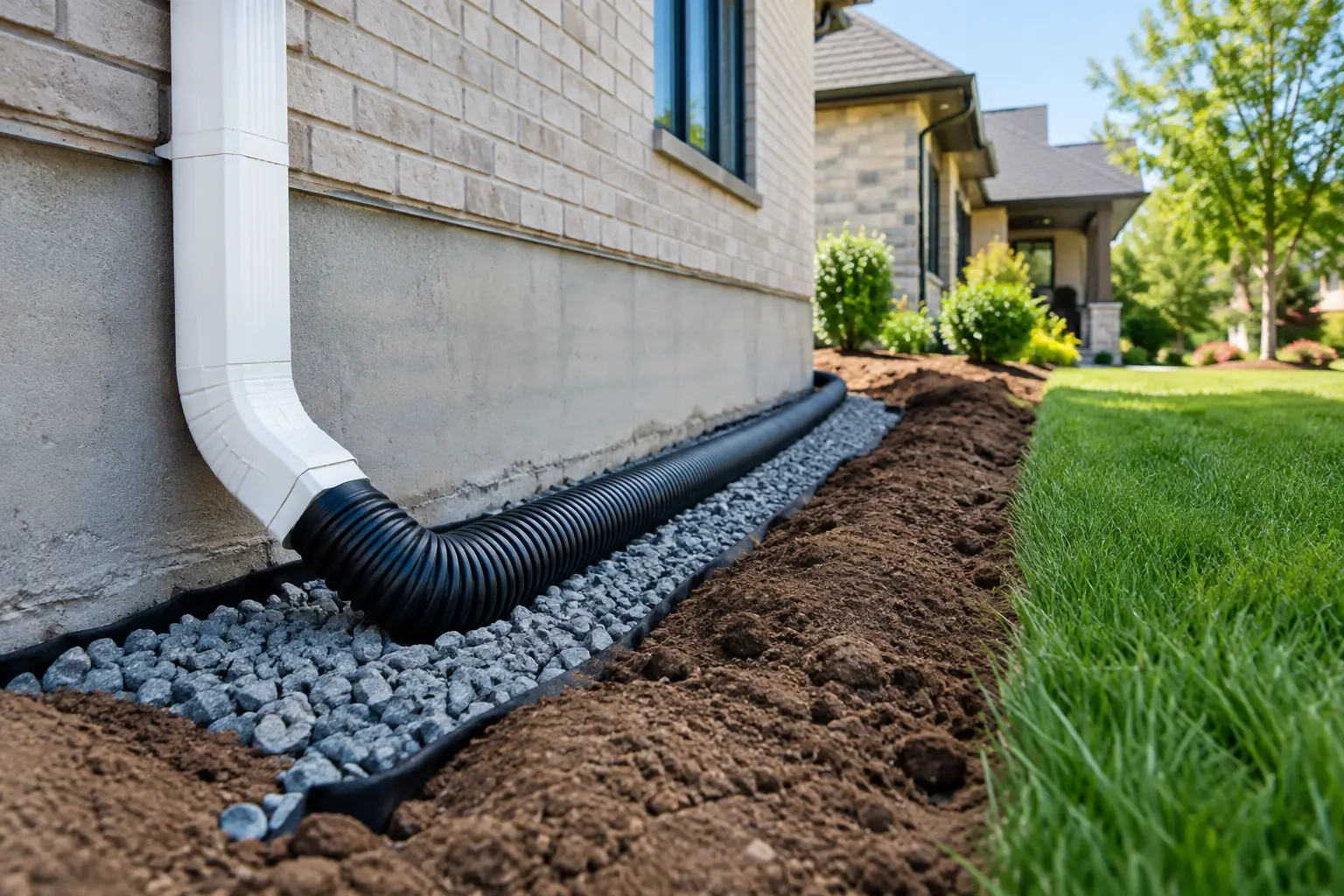
A foundation problem often begins where most buyers and homeowners are not looking: at the soil line after a hard rain. Water may stand beside the brick veneer, spill from short downspouts, or collect in a low area where previous owners added mulch to hide the grade. In Southeast Texas, repeated wet-dry cycles can affect expansive soils and contribute to movement around slab foundations. The best foundation drainage solutions move water away from the structure while keeping soil moisture as consistent as practical.
There is no single drain system that works for every property. A home on a flat Beaumont-area lot with heavy clay soil needs a different approach than a raised rural home near a ditch or a house on a coastal lot with a high water table. The right repair starts with identifying where water comes from, where it travels, and whether the existing grade gives it a path away from the building.
Start With Surface Water Control
Surface drainage is usually the first and most cost-effective line of defense. Before installing a French drain or excavating around the foundation, evaluate the simple conditions that direct rainwater toward the house.
The finished soil should slope away from the foundation. A commonly used target is a drop of about 6 inches over the first 10 feet where site conditions allow. The exact slope depends on the lot, landscaping, pavement, and drainage outlet, but the principle remains the same: water should not be directed back toward the slab or crawlspace.
During an inspection, concerning conditions often include soil piled high against the wall, flower beds shaped like a basin, settled areas along the foundation perimeter, and patios that slope toward the house. These conditions can allow water to remain near the structure long after a storm has passed. Adding soil may correct a shallow low spot, but it must not cover brick weep holes, siding clearance, vents, or other components that require exposure.
Roof runoff also deserves close attention. A large roof can discharge a surprising amount of water during a Southeast Texas downpour. Gutters should be securely attached, reasonably clean, and sized and positioned to capture runoff. Downspouts should discharge well away from the foundation, preferably into a properly planned drainage route rather than directly onto a walkway or flower bed that returns water to the home.
Extensions are simple, but they need a real destination. Pointing a downspout toward a neighboring lot, a driveway that drains back toward the home, or a low corner with no outlet merely moves the problem a few feet. Buried downspout lines can be effective when they are properly sloped, protected from crushing, and discharged to an approved location.
Best Foundation Drainage Solutions by Condition
The best system is determined by the source of water and the limits of the site. Installing an expensive drain without correcting the grade or roof runoff can leave the original problem in place.
Regrading and swales for broad runoff
Regrading is often the right solution when water approaches the home from the surrounding yard or settles around multiple sides of the structure. Soil is reshaped to create positive drainage away from the foundation. On larger properties, a shallow swale can collect and guide surface runoff toward a suitable outlet.
This approach works best when there is enough room and elevation change to establish a route. It may be less practical on tightly spaced subdivision lots, where fences, neighboring grades, and easements limit where water can go. Regrading also requires care around irrigation heads, utility lines, trees, and exterior finishes.
Gutters and extended downspouts for roof runoff
For many homes, gutter corrections provide the fastest improvement. This is especially true where erosion or splash marks are visible below roof edges, or where concentrated runoff has formed trenches beside the foundation. A downspout extension can be above ground, buried, or connected to a catch basin system.
Gutters are not maintenance-free. Leaves, pine needles, roofing granules, and storm debris can block flow and cause water to overflow at the very area they are meant to protect. Homeowners should inspect gutters after major storms and keep discharge points open.
Area drains for low patios and paved surfaces
Area drains are designed to collect water at a specific low point, such as a patio, courtyard, driveway edge, or stairwell. They are particularly useful when concrete flatwork cannot be re-sloped easily or when a low area is unavoidable.
An area drain only performs as well as its outlet. The basin, grate, piping, and discharge point must remain clear, and the line must have adequate fall or an appropriate pump arrangement. If a drain line is buried with no reliable outlet, it can hold water, clog with sediment, and become another maintenance issue.
French drains for subsurface water
A French drain generally uses perforated pipe surrounded by washed stone and filter fabric to collect water moving through soil. It can help reduce saturation in a persistently wet landscape area or intercept water moving toward a foundation from higher ground.
French drains are frequently recommended as a cure-all, but they have limits. They are not a substitute for correcting roof discharge, poor grading, or plumbing leaks. In areas with dense clay soil, the drain trench may collect water slowly, and the installation needs a functional discharge point. Poorly installed fabric, undersized stone, crushed pipe, or a pipe that lacks slope can sharply reduce performance.
Channel drains for doors and garage openings
A linear channel drain may be appropriate at a garage threshold, patio door, or transition where water flows across concrete toward an opening. This is a targeted solution for a predictable surface-water path. It does not correct a yard that consistently holds water against the foundation, but it can protect a vulnerable entry when properly tied into drainage piping.
Drainage Details That Can Create New Problems
Drainage work should protect both the foundation and the building envelope. For brick veneer homes, soil and mulch should remain below weep holes so moisture within the wall cavity has a path to exit. Covering these openings can increase the risk of concealed moisture conditions and can also create easier access for wood-destroying insects.
Water should not be concentrated near pier-and-beam crawlspaces. Standing water beneath a raised home can contribute to elevated moisture, fungal growth, wood deterioration, and conditions attractive to termites. Crawlspace drainage may involve exterior grading, gutter control, perimeter collection, and in some situations a properly installed vapor barrier. The correct combination depends on the source of moisture, not just the visible puddle.
Avoid directing water toward a septic system, wellhead, neighboring property, or public right-of-way without understanding local requirements. On rural properties, site drainage must also account for driveways, ditches, culverts, and the natural flow of the land. A repair that looks effective during a light shower may fail when roadside ditches are full during a major storm.
When Drainage and Foundation Movement Need Closer Review
Drainage problems can contribute to foundation movement, but they are not the only cause. Cracks in drywall or brick, sticking doors, sloping floors, separated trim, and gaps at exterior joints should be evaluated in context. Some cracking may be cosmetic or historic; other patterns may indicate active or differential movement.
A careful assessment looks beyond one crack. Inspectors compare visible symptoms, site drainage, plumbing indications, roof runoff, vegetation, grading, and the overall age and construction of the home. At Texas Country Inspection, foundation observations may be supported by hydro-static altimeter readings and infrared thermography when conditions and the scope of the inspection warrant it. These tools add useful information, but they do not replace the need to follow water from the roofline to its final discharge point.
If significant movement or ongoing moisture intrusion is suspected, a qualified foundation specialist, drainage contractor, plumber, or structural engineer may be needed, depending on the findings. Be cautious of anyone who recommends major excavation or foundation repair without documenting the water-management issue and the evidence supporting the recommendation.
A Practical Way to Prioritize Repairs
Begin with observations made during or soon after rainfall. Note where water leaves the roof, where it ponds, how long it remains, and whether it reaches the foundation or crawlspace. Then address obvious defects first: overflowing gutters, disconnected downspouts, negative grade, blocked swales, and settled soil along the perimeter.
If water still persists after those corrections, a more targeted system such as an area drain, channel drain, or French drain may be justified. Obtain a plan that identifies pipe locations, cleanouts, slope, discharge point, and how the system will be maintained. The best drainage work is not hidden pipe alone. It is a complete route that collects water, carries it reliably, and releases it where it will not return to the structure.
A dry foundation perimeter is not always realistic in Southeast Texas after prolonged rain. The goal is more practical: prevent concentrated water from standing against the house, reduce repeated saturation, and give each storm a controlled path away from your investment.

5 Comments