
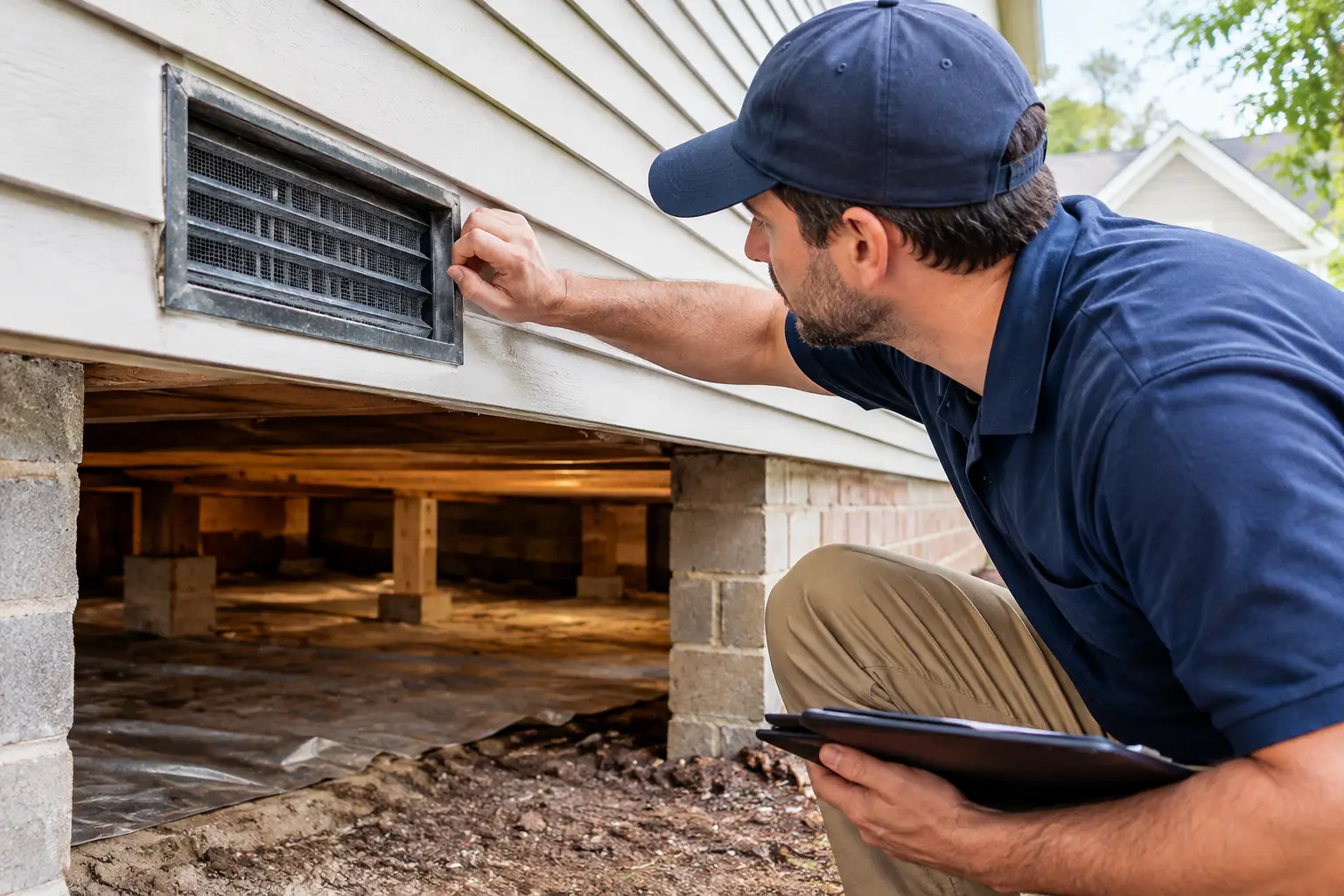
A crawl space can look dry from the access opening and still be holding enough moisture to damage a home from below. In Southeast Texas, high outdoor humidity, heavy rain, flat site conditions, and plumbing leaks can combine to create crawl space ventilation problems that are easy to miss during a casual walk-through. The result may be fungal growth, soft subflooring, decayed framing, insulation damage, or conditions favorable to termites and other wood-destroying insects.
For a buyer, this matters because crawl space defects are often concealed by insulation, limited access, standing water, or stored materials. For an owner, it matters because a moisture condition rarely corrects itself. A careful inspection should identify the source of moisture, the condition of the structure, and whether the existing ventilation approach is helping or making the situation worse.
Why Ventilation Is Not a Simple Fix
Many older homes were built with foundation vents intended to move outside air through the crawl space. The basic idea was sound for certain climates: exchange damp air beneath the home with drier outside air. In humid Texas weather, however, outside air is not always drier. Warm, moisture-laden air entering a cooler crawl space can raise the relative humidity beneath the house and allow condensation to form on cooler surfaces.
That does not mean every foundation vent should be closed. It means the crawl space needs to be evaluated as a system. The right correction depends on drainage, ground moisture, plumbing conditions, insulation, mechanical equipment, the amount of conditioned air entering the area, and the construction of the home. Closing vents without addressing these factors can trap an existing moisture problem. Leaving vents open when surface drainage is poor may allow humid air and wind-driven rain to add to it.
A professional evaluation should avoid one-size-fits-all recommendations. The central question is not simply whether vents are open or closed. It is why the crawl space is wet or humid in the first place.
Common Crawl Space Ventilation Problems We Find
Blocked, Missing, or Damaged Foundation Vents
A vent covered by soil, mulch, siding, insulation, or debris cannot perform its intended function. Damaged screens can also admit rodents, insects, and other pests. In some homes, vents have been sealed during prior repairs with foam, plywood, masonry, or plastic without a coordinated moisture-control plan.
The defect may be as straightforward as restoring clearance and screening. But if vents were intentionally blocked after an encapsulation or conditioning upgrade, reopening them could be the wrong move. The condition of the vapor barrier and dehumidification system must be considered first.
Poor Drainage at the Foundation
Water management outside the home has a direct effect on conditions underneath it. Roof runoff discharged near the foundation, negative grading, low crawl space elevation, or standing water after a storm can keep soil damp for extended periods. Moisture then evaporates from the ground into the enclosed area below the floor.
This is especially relevant around the Golden Triangle and other low-lying Southeast Texas communities, where intense rain events can overwhelm marginal drainage. A crawl space may have adequate vents on paper but still remain damp because water is being directed toward the house. Correcting drainage is often more important than adding another vent.
Missing or Deteriorated Ground Vapor Barriers
Bare soil releases moisture continuously. A properly installed ground vapor barrier limits that evaporation and is a major part of crawl space moisture control. During inspections, common concerns include missing plastic, thin or deteriorated material, incomplete coverage, large tears, and seams that are not adequately overlapped or sealed where a sealed crawl space system is intended.
A vapor barrier is not a cure for active water entry. If water is flowing under the home from a plumbing leak or poor drainage, plastic alone can conceal the problem while water remains trapped beneath it. The source must be corrected first.
Condensation From HVAC Ducts and Equipment
Cold air-conditioning ducts running through a hot, humid crawl space can sweat when insulation is damaged, missing, compressed, or poorly sealed. Condensation may drip onto soil, insulation, framing, or duct supports. Over time, this can lead to wet insulation, rusted metal components, and microbial growth.
An air handler or condensate drain line located below the home deserves close attention as well. A blocked drain, failed auxiliary pan, disconnected line, or improperly routed discharge can add a surprising amount of water to a crawl space. These conditions are sometimes mistaken for a ventilation issue when the primary problem is mechanical or plumbing-related.
Plumbing Leaks and Drainage Defects
Small plumbing leaks are particularly destructive because they can continue unnoticed for months. A slow drip at a supply connection, drain fitting, water heater line, or under-slab penetration may keep nearby wood and soil damp without producing an obvious interior stain.
Wastewater leaks create an additional sanitation concern. An inspection should distinguish between active leakage, past staining, and moisture conditions that cannot be fully confirmed without further testing. Where evidence points to an active plumbing defect, repair by a qualified plumber should come before decisions about ventilation upgrades.
Inadequate Crawl Space Access
A crawl space cannot be properly maintained if it cannot be safely accessed. Undersized openings, damaged doors, obstructed entries, and low clearances limit the ability to inspect framing, plumbing, ducts, and pest activity. They also make future repairs more expensive.
Access doors should fit securely and help limit pest intrusion and bulk water entry. At the same time, an access opening should not be permanently sealed in a way that prevents necessary inspection. Termite inspections and structural evaluations depend on reasonable visibility where conditions allow.
Moisture Damage Often Looks Like More Than a Ventilation Issue
The consequences of chronic crawl space moisture can appear throughout the home. Floors may feel uneven or soft. Doors may bind as framing and foundation conditions change. Musty odors can migrate into living areas through gaps around plumbing, ducts, and floor penetrations. Insulation may sag or fall away from the subfloor.
Moisture also changes the risk profile for wood-destroying insects. Subterranean termites require moisture, and persistently damp structural wood is more attractive and more vulnerable than dry wood. Fungal decay can weaken joists, girders, sill plates, and subflooring, sometimes in areas that are not visible from inside the house.
It is important not to assume that every dark area on wood is active mold or every soft board is active decay. An experienced inspection documents visible evidence, identifies likely contributing conditions, and recommends further evaluation or repair when the extent cannot be determined visually. That distinction protects buyers from both missed defects and unsupported conclusions.
Vented, Sealed, or Conditioned: Which Approach Fits?
A traditionally vented crawl space may perform acceptably when the site drains well, the ground is covered, plumbing is sound, and the structure is maintained. However, the humid climate in much of Texas can make this arrangement difficult to manage, particularly after prolonged rain.
A sealed or encapsulated crawl space generally uses a continuous vapor barrier, sealed openings, controlled drainage, and a method of humidity control such as a dehumidifier or properly designed conditioned-air strategy. This can provide better control, but it is not simply a matter of closing vents and putting plastic on the ground. The system must be installed and maintained correctly. A failed dehumidifier, wet foundation wall, or hidden plumbing leak can still create significant damage in a sealed space.
The trade-off is cost and maintenance. Encapsulation can be a sound long-term investment for a persistently damp crawl space, but it may be unnecessary where a drainage repair, plumbing repair, and improved ground cover solve the actual problem. Buyers should be cautious when a contractor recommends a major system without identifying the moisture source.
What a Thorough Crawl Space Inspection Should Document
For a real estate transaction, general statements such as “moisture present” are not enough. The report should describe where the condition was observed and why it matters. Texas Country Inspection evaluates visible crawl space conditions with attention to foundation components, floor framing, subflooring, insulation, vents, access points, plumbing, HVAC components, drainage indicators, and evidence of wood-destroying insects.
Useful documentation may include visible fungal growth, wood rot, moisture staining, standing water, damaged vapor barriers, leaking pipes, sweating ducts, insulation deterioration, blocked vents, or earth-to-wood contact. In some cases, infrared thermography can help identify temperature patterns associated with moisture, although it does not replace direct observation or moisture testing. When access or visibility is restricted, that limitation should be clearly reported.
For buyers, the most productive next step is to obtain repair opinions that address cause and extent. A structural contractor may be needed for damaged framing, a plumber for active leaks, an HVAC contractor for sweating ducts or condensate issues, and a pest professional when termite activity or conducive conditions are found. The goal is coordinated repair, not a collection of disconnected fixes.
When to Act Before Damage Spreads
A musty odor, cupped flooring, recurring condensation, or a crawl space that remains wet after normal drying time should not be treated as cosmetic. The same applies to visible fungal growth, deteriorated joists, fallen insulation, termite shelter tubes, or water pooled beneath the home. These are conditions that warrant further evaluation before closing on a property or before beginning a cosmetic remodel.
The most helpful repair plan starts with a careful look below the floor, where the evidence usually is. Once the moisture source is identified and the condition of the wood structure is documented, homeowners can make a practical decision about drainage, ventilation, sealing, or repair with far less uncertainty.
