
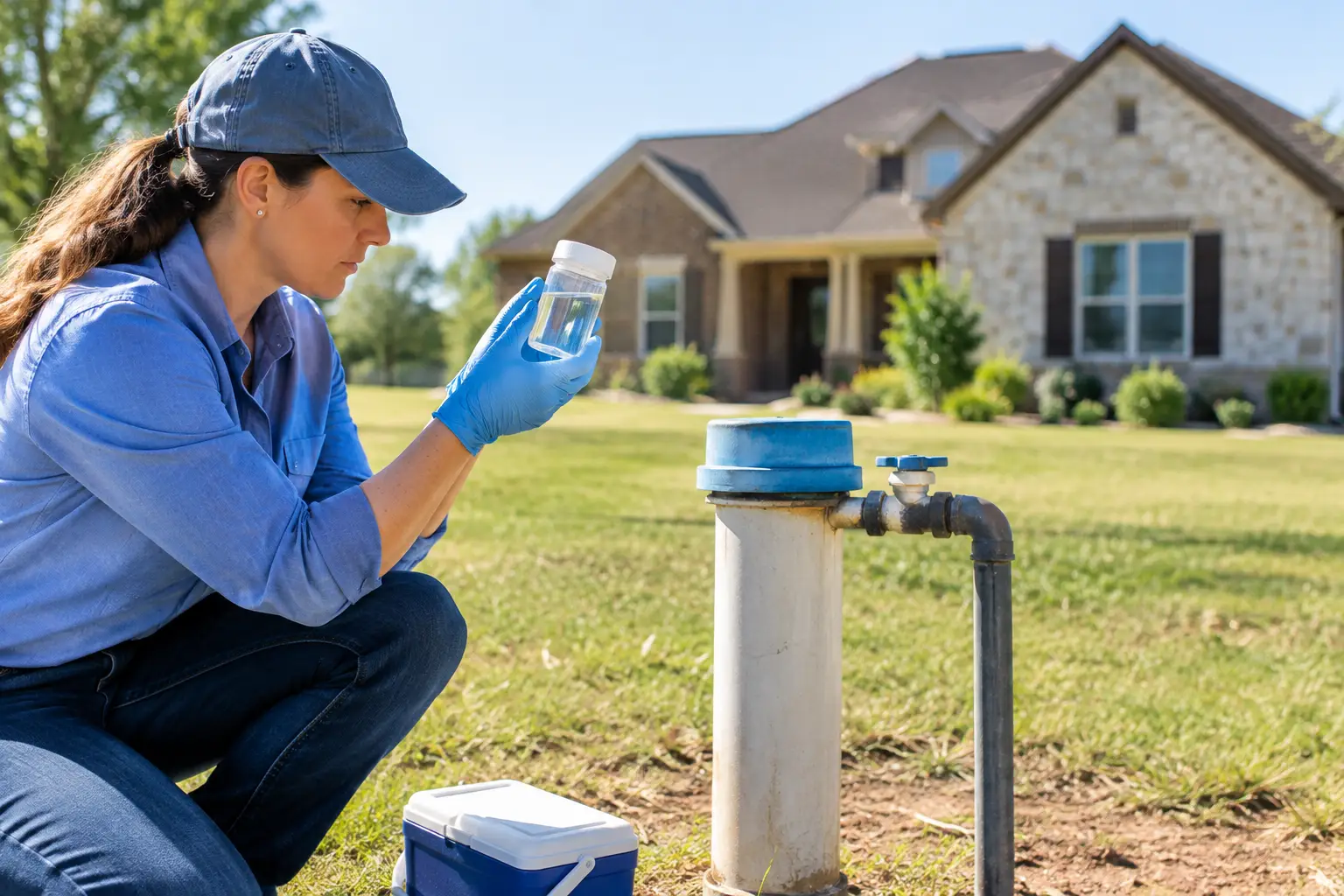
A private well can supply a rural property for decades, but clear water is not proof of safe water. A proper water well sampling guide matters because bacteria, nitrate, metals, and other concerns are often invisible, odorless, and easy to miss during a showing. For a buyer, the goal is not simply to obtain a passing lab report. It is to collect a representative sample, understand what the selected tests can and cannot tell you, and identify property conditions that may affect the well over time.
In Southeast Texas, well performance and water quality can be influenced by heavy rainfall, flooding, shallow groundwater conditions, nearby septic systems, aging well components, and changing use of surrounding land. Sampling should be treated as part of the property due diligence process, alongside the home, septic system, drainage, and site inspection.
What a Water Sample Can Tell You
A laboratory analysis measures the water that reaches the sample bottle at a specific point in time. It can identify certain contaminants or water-quality characteristics, depending on the test package ordered. Common real estate transaction testing often includes total coliform bacteria and E. coli, along with basic water chemistry such as nitrate, nitrite, pH, hardness, iron, manganese, chloride, sulfate, and total dissolved solids.
Bacteria testing is often the first concern because it can indicate that surface contamination or waste-related contamination has entered the well system. Total coliform results do not automatically mean the water contains a disease-causing organism, but they do indicate the system needs further evaluation. An E. coli result is more serious because it suggests fecal contamination and requires prompt attention.
Chemistry results help explain how the water may affect people, plumbing, fixtures, appliances, and treatment equipment. High iron or manganese can stain plumbing fixtures and laundry. Elevated hardness can shorten the service life of water heaters and leave scale on fixtures. Chloride or total dissolved solids can affect taste and may point to naturally occurring mineral content, saltwater influence, or other local conditions. Nitrate is especially relevant where septic systems, livestock, fertilizer use, or shallow groundwater may be present.
A standard test is not a guarantee that every possible contaminant has been ruled out. Testing for lead, arsenic, volatile organic compounds, pesticides, radon, or other analytes usually requires a separate request. The right panel depends on the property location, well depth and construction, nearby activities, lender requirements, prior test results, and visible site conditions.
Water Well Sampling Guide: Start Before the Sample Is Drawn
Reliable results begin with an inspection of the well and the sample location. A sample may be taken from an interior faucet or an exterior point, depending on the laboratory instructions and the purpose of the test. The sample point should be selected carefully. Sampling after a water softener, reverse-osmosis filter, ultraviolet unit, or other treatment device may show treated water rather than the raw water produced by the well.
For transaction decisions, it is often useful to understand both the well’s untreated source water and the condition of any installed treatment system. If water is sampled before treatment, the result helps identify what the well is producing. If it is sampled after treatment, the result can help confirm whether the treatment equipment is performing as intended. These are different questions, and one sample does not always answer both.
Before collection, look for conditions that can affect the result or signal a larger problem. These include a damaged or missing well cap, an open electrical conduit, loose casing, standing water around the wellhead, improper grading, animal access, evidence of recent flooding, or a wellhead located too close to septic components. A clean laboratory result does not erase a visible wellhead defect that could allow contamination later.
Ask whether the system has recently been disinfected, repaired, flooded, unused for an extended period, or placed under unusual demand. Chlorination can suppress bacteria temporarily and may produce a result that does not reflect normal conditions. A recently installed filter, a new pressure tank, or a pump repair can also change what reaches the faucet. These details should be disclosed to the laboratory and considered when interpreting the report.
How to Collect a Representative Water Sample
Laboratories provide specific bottles, preservatives, holding times, and instructions. Those instructions control the process. A bacterial sample bottle may contain a preservative and should never be rinsed, touched inside the cap, or filled from a faucet contaminated by hands, hoses, or aerators.
The faucet should generally be a cold-water tap with no swivel screen, filter, hose connection, or mixing valve if possible. Remove the aerator when the laboratory permits it, then clean or disinfect the faucet outlet according to the collection protocol. Run the water long enough to clear water that has been sitting in the plumbing and to draw water that represents the well system. The proper flushing time varies with the plumbing layout and laboratory instructions, but collecting the first water from a stagnant line is rarely useful.
Do not collect a bacteria sample from a faucet supplied by a water filter, softened-water loop, refrigerator dispenser, or hose bibb unless the laboratory specifically directs otherwise. Avoid sampling from a faucet with a leaking stem, heavy corrosion, or debris at the outlet. Those conditions can contaminate the sample and create uncertainty about whether the result reflects the well or the fixture.
Fill bottles to the indicated line, cap them immediately, label them accurately, and protect them from heat. Many bacterial samples have a short laboratory holding time. If the sample is collected late on a Friday and cannot reach the laboratory promptly, the lab may reject it or the results may be less useful. Coordination matters as much as collection.
A complete chain of custody should identify the property, collection date and time, sampler, sample point, and requested analysis. During a real estate transaction, this documentation helps prevent confusion when several wells, treatment systems, or outbuildings are present on the same property.
When a Well Should Be Tested
For buyers, testing should occur early enough to allow for resampling, repairs, treatment estimates, or further evaluation before option and financing deadlines expire. Waiting until the final days before closing leaves little time to investigate a positive bacteria result or a chemistry concern.
A well should also be tested after flooding, a known well-cap failure, septic repairs or failure, a long vacancy, a change in taste or odor, pump work, or an unexplained gastrointestinal illness among occupants. Annual bacteria testing is a prudent baseline for many private well owners, while broader chemistry testing may be scheduled periodically or whenever local conditions change.
Recent heavy rain deserves attention in the Golden Triangle and other low-lying Southeast Texas areas. Rain alone does not make every well unsafe, but it can reveal vulnerabilities in a poorly sealed wellhead or a site with drainage that directs runoff toward the casing. If a sample is collected immediately after a major weather event, document that fact. A follow-up sample under normal conditions may be appropriate if results are questionable.
Reading Results Without Overreacting
A laboratory report should be read in context. A positive total coliform result may require disinfection, wellhead repair, plumbing review, and repeat testing. It may also point to contamination at the faucet rather than the well, which is why sound collection procedures matter. Repeated positive results deserve more attention than a single questionable sample.
High iron, hardness, or manganese can be common water-quality issues rather than immediate health emergencies, yet they still carry cost implications. They may require filtration, softening, oxidation, or maintenance of existing equipment. A buyer should consider the cost of treatment, replacement filters, salt, service calls, and any likely effect on plumbing fixtures and appliances.
Nitrate, E. coli, or other health-related findings call for a more conservative response. Do not assume that a filter system solves the issue without confirming the treatment method is designed for that contaminant and that it is functioning properly. The well, septic system, drainage, land use, and treatment equipment may all need to be evaluated together.
Pair Testing With a Site-Level Inspection
Water quality is only one part of well due diligence. A property inspection can identify observable conditions around the well equipment, pressure tank, pump controls, visible plumbing, drainage, and nearby sources of concern. It cannot certify a well’s yield, internal casing condition, or long-term water quality without specialized evaluation and laboratory testing.
Texas Country Inspection helps clients coordinate water well and laboratory testing so results can be considered alongside the larger property picture. That approach is especially useful when a rural purchase also includes a septic system, older plumbing, evidence of moisture intrusion, or site drainage concerns.
Before you close on a property with a private well, make sure the sample represents the water you intend to use, the test panel addresses the risks present on the site, and the report arrives with enough time to make a clear decision. A careful sample today can prevent a much more expensive surprise after move-in.
