
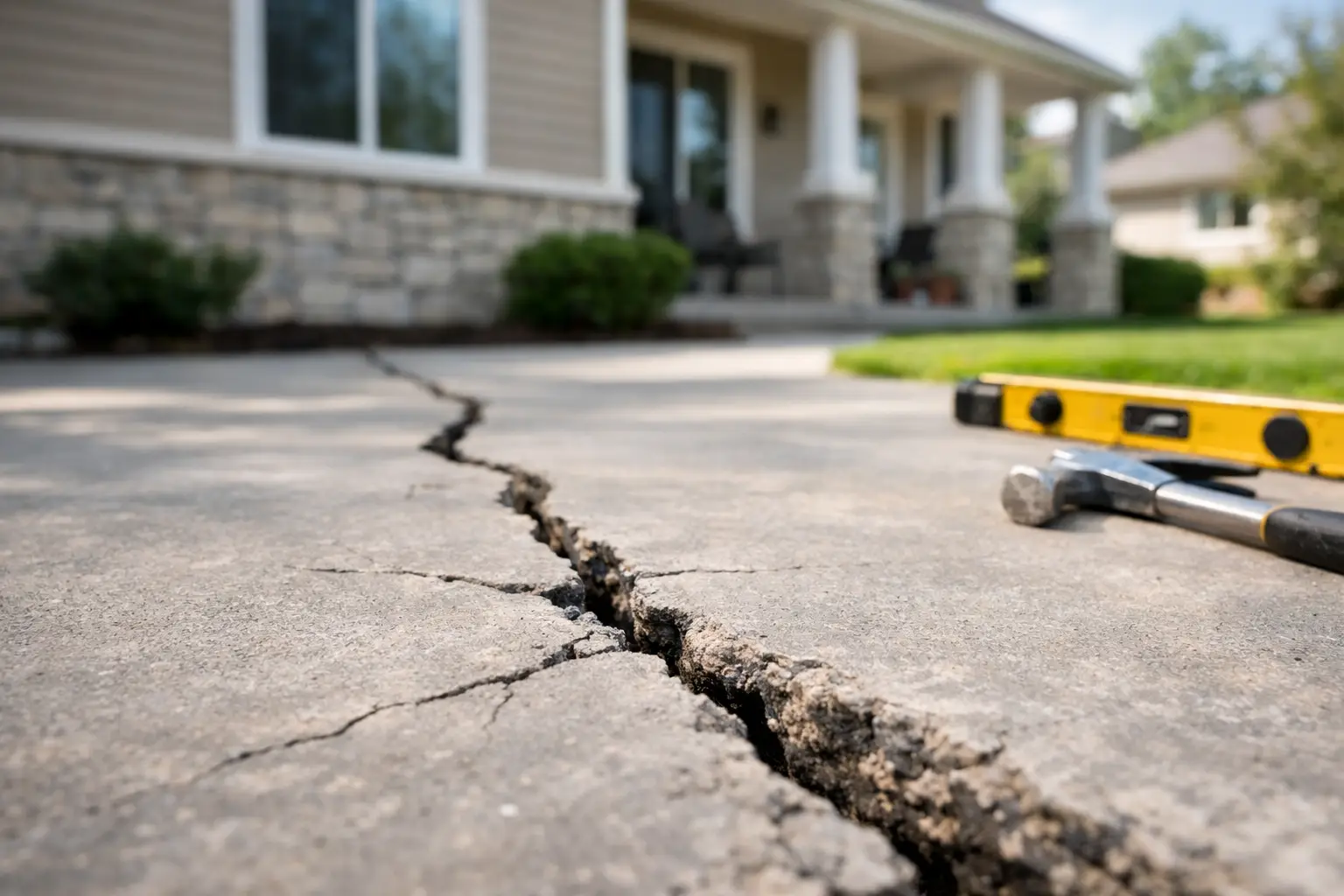
A hairline crack in a garage slab may be nothing more than shrinkage. A widening crack running through tile, brick veneer, and interior walls is a different story. When buyers and homeowners ask what causes slab foundation cracks, the honest answer is that not all cracks mean the same thing, and the pattern matters as much as the crack itself.
In Southeast Texas, slab performance is closely tied to soil behavior, drainage conditions, plumbing risks, and moisture changes over time. A slab is not just a concrete pad resting on calm, unchanging ground. It is part of a system that depends on stable support, proper site grading, and consistent moisture conditions around the structure. When one part of that system changes, cracking can follow.
What causes slab foundation cracks in the first place?
Concrete cracks because it is strong in compression but weaker when it is pulled, bent, or unevenly supported. Some cracking begins early, during curing, as concrete loses moisture and shrinks. Other cracking develops later when the soil under the slab expands, contracts, erodes, or settles.
That distinction is important. A minor shrinkage crack may be cosmetic and expected. A crack tied to differential movement means one section of the slab is behaving differently from another. That is when inspectors start paying attention to related evidence such as doors sticking, floor slope changes, wall cracking, separated trim, and exterior masonry distress.
Soil movement is one of the most common causes
Much of Southeast Texas deals with clay-rich soils that react to moisture. When expansive clay gets wet, it can swell. When it dries out, it can shrink and lose volume. That repeated cycle places stress on slab foundations, especially if moisture is not consistent around the perimeter.
A slab does not have to move dramatically to crack. Small changes in support can create enough tension for cracking to appear in the concrete itself or in the finishes above it. One corner of a home may stay wetter because of poor drainage, while another area dries out from sun exposure or tree root activity. The result can be differential movement, where one portion of the slab rises or drops more than another.
This is one reason foundation issues in this region are rarely a simple yes-or-no condition. The soil may be active, but the severity depends on construction type, drainage control, vegetation, plumbing condition, and how long the movement has been occurring.
Poor drainage puts extra stress on a slab
Water management around the structure is a major factor in slab performance. If roof runoff discharges next to the house, if the yard slopes toward the foundation, or if low areas hold water after rain, the soil around the slab can become oversaturated. Over time, that can soften support conditions or increase expansion in certain areas.
On the other hand, long dry periods can pull moisture out of the soil and cause shrinkage. Neither extreme is helpful. Slabs tend to perform better when moisture conditions remain more consistent.
During an inspection, surface clues often tell part of the story. Erosion channels, negative grading, ponding areas, short downspout discharge points, or hardscape that traps water against the home can all contribute to movement-related cracking. The crack in the slab may be the visible symptom, but drainage is often one of the underlying causes.
Plumbing leaks under the slab can change support conditions
A below-slab plumbing leak can introduce localized moisture into soils that were not meant to stay wet. Depending on the soil type and duration of the leak, this can lead to heaving, soil softening, or loss of uniform support beneath parts of the slab.
Not every slab crack means there is a plumbing leak, and not every plumbing leak causes dramatic movement. Still, it is a possibility that should be considered when cracks appear alongside unexplained moisture, elevated water bills, warm floor areas, or signs of foundation movement with no obvious exterior drainage explanation.
In practical terms, this is where experience matters. Crack patterns, floor elevation readings, and the location of interior symptoms can help determine whether additional plumbing evaluation should be recommended.
Tree roots and vegetation can dry soils unevenly
Large trees near the home often affect the moisture content of supporting soils. Their roots do not usually break a slab the way people sometimes imagine, but they can remove substantial moisture from clay soils. That can lead to shrinkage near one section of the foundation while other areas remain more stable.
The effect is not always immediate. A foundation may perform acceptably for years, then begin to show movement after drought conditions, tree growth, or changes in irrigation patterns. This is another reason a crack must be evaluated in context. The crack itself is only one clue.
Construction and curing issues can also cause cracks
Some slab cracks are tied to how the concrete was placed, reinforced, or cured. If concrete dries too quickly, if control joints are limited or poorly located, or if reinforcement is inadequate for site conditions, cracking may occur earlier and more noticeably.
That does not automatically mean the foundation is failing. Concrete naturally shrinks as it cures, and controlled cracking is part of the reason control joints exist. But when cracking appears excessive, offset, or associated with broader structural symptoms, the concern shifts from normal concrete behavior to possible movement or support problems.
In older homes, age and long-term performance also matter. A decades-old slab may show stable, minor cracking that has not changed meaningfully in years. A newer slab with active displacement or repeated finish damage deserves closer attention.
What causes slab foundation cracks that are more serious?
The more serious cracks are usually tied to movement, not simple surface shrinkage. Inspectors become more concerned when cracks show vertical displacement, widening separation, repeated patching history, or coordination with other signs such as:
- interior wall and ceiling cracks, especially above doors and windows
- sticking doors or windows
- sloping or uneven floors
- separated baseboards or trim
- exterior brick cracks in stair-step patterns
- gaps at expansion joints, porches, or garage slabs
A single crack may not tell the full story. A pattern across multiple components often does. That is why a foundation evaluation should not focus only on the concrete surface. The house gives off clues when the slab is moving.
Cosmetic cracks versus movement-related cracks
Hairline cracks with little to no displacement are often less concerning than wider cracks that continue to change. Garage slabs, patios, and sidewalks commonly crack from shrinkage, thermal stress, and normal wear. Those cracks may not indicate structural failure of the main home foundation.
Inside the home, the distinction becomes more important. If floor finishes are cracking directly above slab cracks, if displacement is measurable, or if there is a concentration of related distress in one area of the structure, the issue deserves a more technical review.
This is where buyers should be careful about broad assumptions. Saying all slab cracks are normal is careless. Saying every crack means major foundation repair is just as careless. The right answer depends on the crack type, location, width, displacement, age, and associated conditions.
How slab cracks are evaluated during an inspection
A careful inspection looks beyond the obvious. Crack width and direction are noted, but so are elevation changes, drainage patterns, exterior cladding distress, moisture conditions, and signs of prior repair. In some cases, hydro-static altimeter readings help document floor elevation differences and identify areas of possible movement. Infrared imaging may also help identify moisture-related anomalies that deserve follow-up.
The goal is not to overstate the problem or downplay it. The goal is to document what is visible, explain what those findings may indicate, and recommend the next step when conditions warrant further evaluation.
For buyers, that can affect negotiations, repair planning, and long-term budgeting. For homeowners, it can help separate maintenance issues from larger structural concerns.
What homeowners can do to reduce future cracking
No slab can be guaranteed crack-free, especially in shifting soils, but risk can be reduced. Consistent drainage control is one of the biggest factors. Roof runoff should discharge away from the home, standing water should be corrected, and grading should not direct water back toward the slab.
Moisture consistency around the foundation also matters. Extreme wet-dry cycles are hard on expansive soils. Vegetation should be managed carefully, especially large trees close to the home. Plumbing concerns should be addressed promptly if a leak is suspected.
Just as important, changes should be monitored instead of ignored. A stable hairline crack may remain only a maintenance item. A crack that grows, offsets, or begins to line up with other symptoms should be documented and professionally evaluated.
At Texas Country Inspection, LLC, foundation concerns are approached the way they should be approached in this region – with measured observations, local soil awareness, and attention to the related signs that tell whether a crack is minor, active, or worth further investigation.
If you are looking at a property with slab cracks, the right question is not simply whether the concrete cracked. The better question is what the crack is telling you about movement, moisture, and support conditions over time.
