
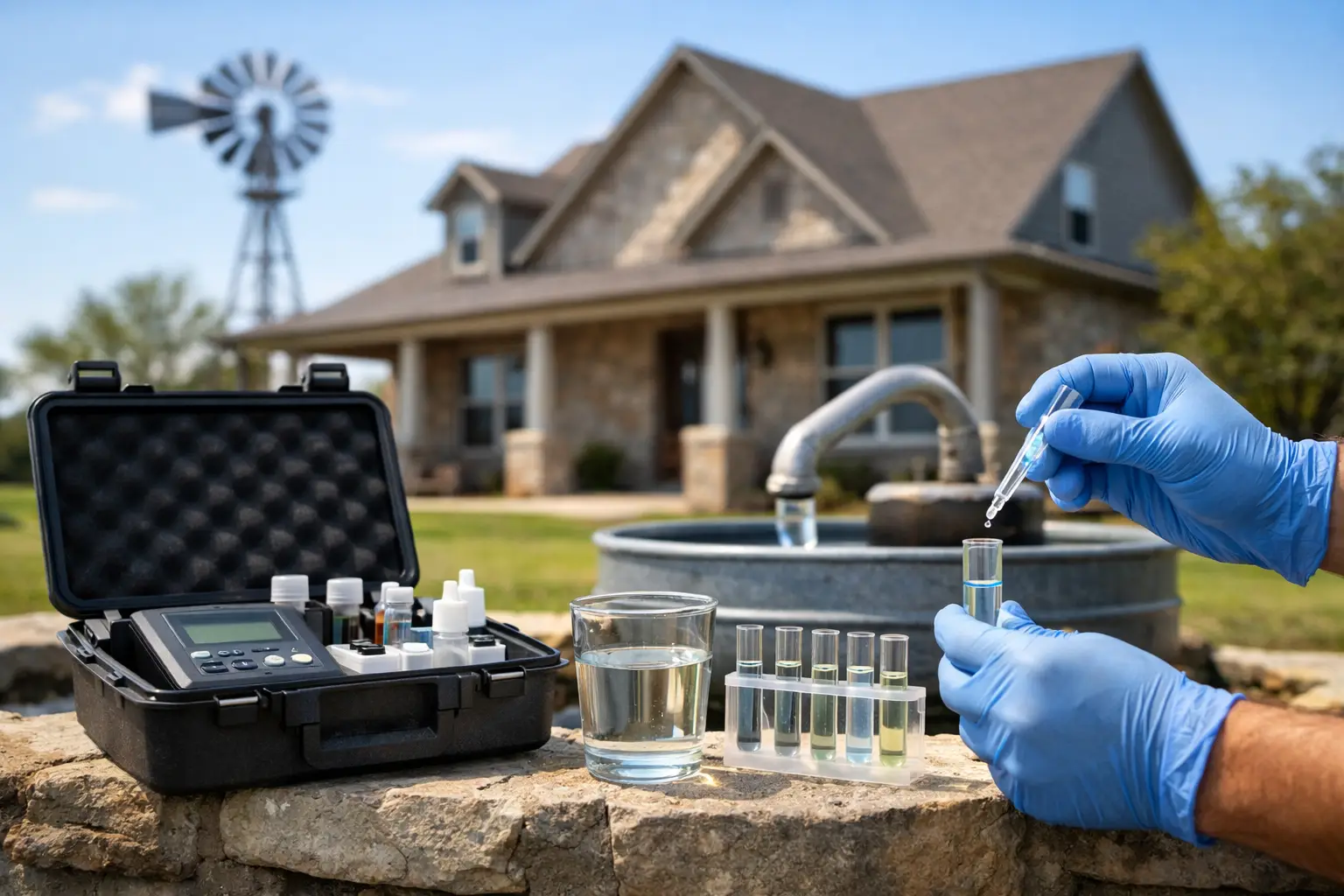
A private well can look fine at the faucet and still have water quality issues that do not show up by taste, odor, or color. That is why a well water testing guide matters for buyers, sellers, and rural property owners in Southeast Texas. When a property depends on a private well, water quality is not handled by a city utility. The responsibility falls on the property owner, and the cost of getting it wrong can be significant.
For a real estate transaction, well testing is not just another box to check. It can affect financing, occupancy decisions, repair negotiations, and long-term maintenance planning. In this region, where rural properties, septic systems, moisture conditions, and variable soil and groundwater conditions are common, water testing should be approached with the same care as the rest of the inspection process.
What a well water testing guide should help you answer
The right approach answers three questions. First, is the water safe to use based on the specific contaminants being tested? Second, are there signs of system or site conditions that could increase future risk? Third, if a result comes back outside acceptable limits, is the issue minor and treatable, or does it point to a larger well, plumbing, or site problem?
That distinction matters. A failed bacteriological sample may be corrected by disinfecting the system and addressing a defective well cap, damaged seal, or drainage issue around the well head. Elevated nitrates may point to a broader contamination concern from nearby agricultural activity, septic influence, or groundwater conditions. Hard water may mainly be a service-life and scaling issue, while lead or arsenic is a much more serious health concern.
When to test well water
For buyers, the best time to test is during the inspection period, early enough to allow for lab turnaround and any needed retesting. Waiting until the end of the option period creates unnecessary pressure. If results raise questions, you need time to review the report, evaluate corrective measures, and decide whether the issue is manageable.
For current owners, annual bacteriological testing is a reasonable baseline, with more complete testing on a periodic basis or whenever conditions change. A change in taste, staining, sediment, odor, pump behavior, nearby flooding, well repairs, or long periods of vacancy all justify additional testing. In Southeast Texas, heavy rains and drainage problems can change site conditions quickly, and those changes can affect water quality.
What to test in a basic well water testing guide
A standard real estate water test often starts with coliform bacteria and E. coli because these results help identify possible contamination pathways. If bacteria is present, the concern is not only the sample result itself, but how contamination may be entering the system.
Beyond bacteria, a practical testing panel often includes nitrates and nitrites, pH, total dissolved solids, and common minerals that affect usability and equipment life. Depending on the property location, history, and lender requirements, additional testing may be appropriate for arsenic, lead, iron, manganese, sulfates, chlorides, and other constituents.
This is where a one-size-fits-all approach falls short. The right panel depends on the property. A rural homesite with nearby livestock, an aging septic system, or shallow groundwater conditions presents different concerns than a newer site with a deeper well and more controlled drainage. If the property has a history of treatment equipment, that is another clue that water quality has been an issue before.
Why Southeast Texas properties need closer attention
Regional conditions matter. Many properties in Southeast Texas deal with high moisture, low-lying ground, drainage limitations, and periods of intense rainfall. Those conditions can increase the chance of surface water influence if the well is poorly protected. Older rural improvements can also have outdated well components, damaged caps, missing seals, or site grading that directs water toward the well instead of away from it.
Water chemistry can vary substantially from one area to another, even between nearby properties. That is why buyers should be cautious about relying on a neighbor’s experience. One well may produce acceptable water while the next lot over has bacteria, sulfur odor, sediment, or elevated minerals. The well construction, depth, surrounding land use, and maintenance history all affect the result.
How samples should be collected
Sample collection is not the place for shortcuts. If the process is done incorrectly, the lab report may not reflect the actual water condition. The sample point matters, bottle handling matters, and timing matters.
For bacteriological samples, the faucet should be prepared correctly to reduce the chance of outside contamination during collection. Aerators, treatment devices, and dirty fixtures can interfere with results. In some cases, collecting after treatment equipment may answer one question, while collecting before treatment equipment answers another. If you want to understand raw well quality, the sampling point should reflect that. If you want to know what occupants are actually consuming, the point of use may also need to be considered.
A careful inspection professional will also look beyond the bottle. Conditions at the well head, visible site drainage, nearby contamination sources, equipment age, pressure tank condition, and plumbing observations all help put lab results in context.
Understanding the results without overreacting
A lab report should not be read in isolation. One abnormal result does not always mean the well is unsafe beyond correction, and one passing result does not guarantee the system has no concerns. Water quality is a combination of lab data, site conditions, and system observations.
Bacteria findings usually call for prompt follow-up because they may indicate an active contamination pathway. That pathway could be as simple as a failed cap or as serious as structural defects in the well or chronic site drainage problems. High nitrates deserve close attention, especially where infants or vulnerable occupants are involved. Elevated iron or manganese may be more of a usability issue, causing staining and taste complaints, but those conditions can still affect the property’s maintenance costs.
It also matters whether the property uses treatment equipment. A water softener, filtration unit, or disinfection system may improve delivered water quality, but buyers still need to know what the raw water condition is and whether the equipment is appropriate, maintained, and sized correctly. Treatment can manage many issues, but it should not be used to hide an unresolved defect in the well system itself.
Well water testing guide for real estate decisions
During a purchase, test results should be weighed alongside the overall inspection findings. If the water test shows contamination and the property also has poor grading, an aging septic system, and deferred maintenance at the well head, the concern is broader than a single failed sample. If the lab result is minor and the system is otherwise well-maintained, corrective action may be straightforward.
This is where buyers benefit from a thorough, field-experienced perspective. A report should help you understand not just what failed, but what likely caused it, what should be evaluated next, and whether the issue appears isolated or systemic. Texas Country Inspection, LLC approaches these concerns the same way it handles other major property systems – by looking for meaningful defects, documenting conditions carefully, and helping clients make decisions based on evidence rather than assumptions.
For sellers, testing before listing can prevent delays and last-minute negotiation problems. For owners, routine testing is part of responsible maintenance, especially when the property depends on private water and no municipal oversight exists.
What testing does not tell you
Water testing has limits. A lab report reflects the sample collected at a particular time under particular conditions. Seasonal changes, rainfall events, pump repairs, or changes in groundwater conditions can alter results later. That is why repeat testing and good system maintenance matter.
Testing also does not replace evaluation of the physical well components. A property may have acceptable water at the moment but still show visible defects such as inadequate well protection, damaged electrical connections, missing covers, or drainage issues that increase future risk. The test result is one part of the picture, not the whole picture.
If you are buying a property with a private well, approach water quality the same way you approach structure, roofing, septic, and wood-destroying insect concerns. Get enough information early, use qualified sampling and lab analysis, and read the results in the context of the property itself. Clean-looking water can still carry risk, and a careful testing plan is often the difference between a manageable repair and an expensive surprise after closing.
A private well can serve a property reliably for years, but only when the water and the system are treated like critical infrastructure rather than an afterthought.
