
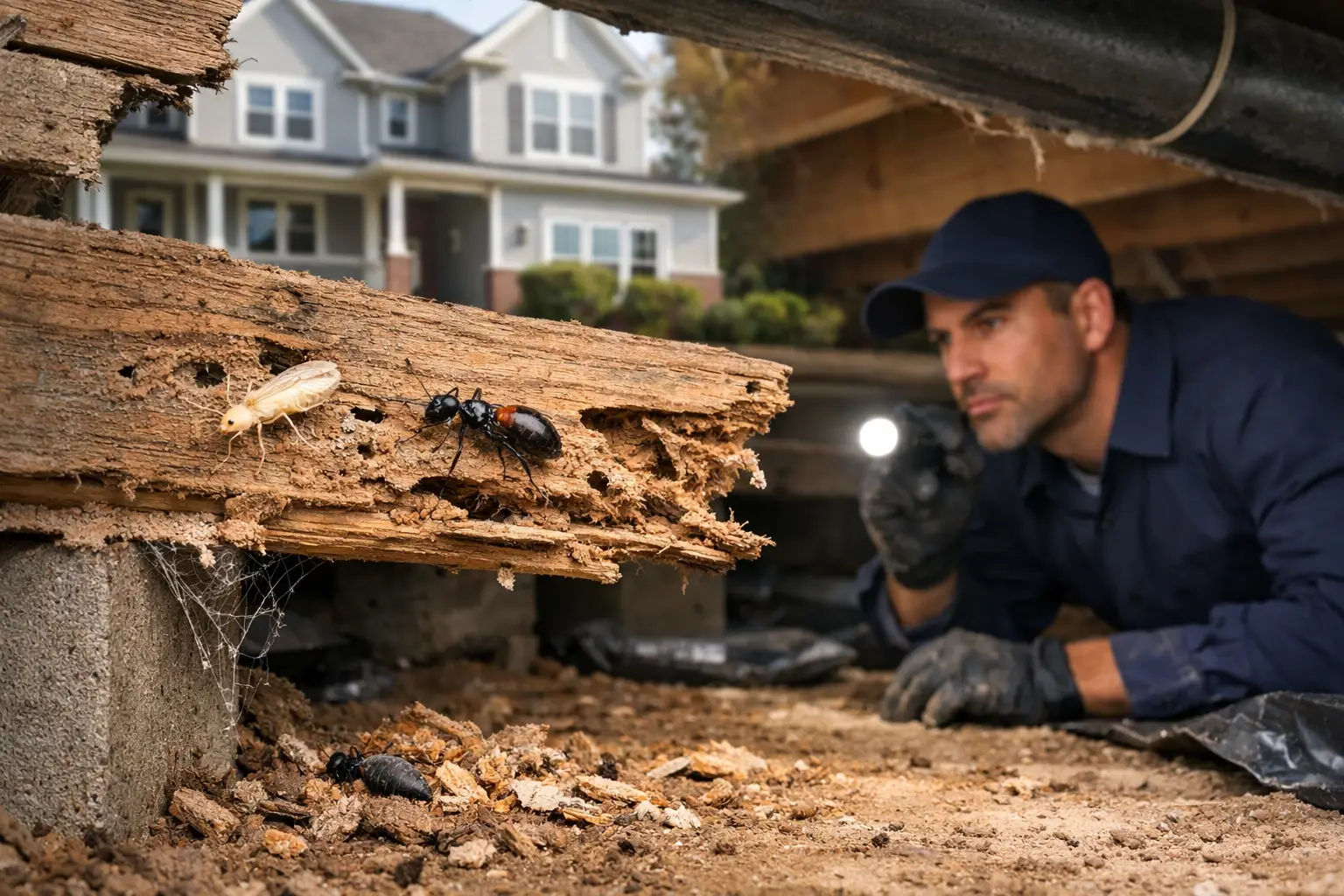
A crawlspace can hold the earliest evidence of a costly wood-destroying insect problem, often well before it becomes visible inside the home. Wood destroying insects in crawlspaces are a frequent concern in Southeast Texas because warm temperatures, high humidity, ground moisture, and concealed framing create favorable conditions for termites and other insects that damage wood. A careful inspection looks beyond a quick flashlight scan. It evaluates the soil, piers, beams, sill plates, subfloor framing, plumbing penetrations, ventilation, and moisture conditions that may be contributing to the problem.
Why Crawlspaces Need a Closer Look
Crawlspaces are out of sight, but they are not low-risk areas. The wood framing beneath a home may be only inches above damp soil, especially where drainage is poor or a vapor barrier is missing, torn, or incomplete. A plumbing leak, condensation on ductwork, clogged gutters, or grade that slopes toward the foundation can keep that area damp for extended periods.
Moisture does not automatically mean insects are present. It does, however, increase the likelihood of conditions that attract subterranean termites and support fungal decay. It can also soften wood, obscure insect evidence, and make a minor issue more difficult to evaluate later. In Southeast Texas, where extended wet periods and high humidity are routine, the relationship between moisture management and wood-destroying insect risk deserves close attention.
A crawlspace inspection also helps identify whether visible damage appears old, active, repaired, or inconclusive. Those distinctions matter during a real estate transaction. A buyer needs to know whether there is current evidence of infestation, whether structural wood has lost significant material, and whether a contributing moisture condition still needs correction.
Common Wood Destroying Insects in Crawlspaces
Subterranean Termites
Subterranean termites are the primary concern in many Texas crawlspaces. They live in the soil and travel between the ground and wood using protected pathways. Their most recognizable evidence is a mud tube, sometimes called a shelter tube, on foundation walls, piers, plumbing penetrations, or framing members.
Termites do not always leave obvious tubes in plain view. They may travel behind insulation, through cracks at slab or masonry interfaces, inside hollow block, or along concealed areas of framing. When wood is probed, termite-damaged areas may sound hollow or break along the grain, leaving layered galleries that contain soil or mud-like material. Active termites may be found in damaged wood, but their absence at the time of inspection does not automatically prove a prior infestation has stopped.
Carpenter Ants
Carpenter ants do not eat wood for nutrition as termites do, but they excavate it to create nesting galleries. They are more likely to be associated with damp, softened, or previously decayed wood. In a crawlspace, inspectors may see smooth, clean-looking galleries, dead ants, insect parts, or coarse sawdust-like material called frass.
Carpenter ant damage can be localized, but it should not be dismissed. Their presence may point to a moisture source that has also caused wood deterioration. Correcting the ant activity without correcting the wet wood, leak, or drainage issue leaves the underlying condition in place.
Wood-Boring Beetles
Wood-boring beetles, including powderpost beetles, may leave small round exit holes and fine powdery frass. Their damage patterns differ from termite damage, and identifying current activity can require close examination. Fresh frass beneath holes, sharp-edged exit holes, or recently exposed interior wood may raise concern for active infestation.
Not every small hole means an active beetle issue. Wood can retain old exit holes for years, and surface staining or dirt can make identification difficult. The age of the damage, the wood species, the extent of affected members, and the presence of fresh material all influence the inspection assessment.
Signs of Wood Destroying Insects in Crawlspaces
A homeowner may never enter the crawlspace, which is why exterior and interior clues also matter. Doors that begin sticking, sagging floors, loose tile, or new cracks can prompt concern, although these symptoms have many possible causes, including foundation movement and moisture-related framing damage. They are not proof of insects by themselves.
Inside the crawlspace, meaningful evidence may include mud tubes, damaged sill plates, weakened floor joists, frass, discarded wings, insect bodies, or wood that appears hollow when carefully probed. An inspector also looks for areas where soil is too close to wood, untreated wood contacts the ground, or debris creates concealed termite pathways.
Conditions that support insect activity deserve documentation even when live insects are not observed. These may include standing water, wet insulation, active plumbing leakage, leaking HVAC condensate lines, poor under-floor ventilation, inadequate drainage, or vegetation and mulch bridging the exterior foundation. In an inspection report, separating observed damage from conditions conducive to infestation helps the client understand what was found and what needs further evaluation.
Damage, Decay, and Structural Significance Are Not the Same Thing
Wood damage in a crawlspace can result from insects, fungal decay, water exposure, poor repairs, or a combination of these issues. For example, a floor joist may have old termite galleries and current moisture decay from a leaking drain line. Treating for termites may be appropriate, but treatment alone will not restore the joist or eliminate the leak.
The structural significance depends on the location and extent of material loss. Damage to a small section of nonstructural blocking is different from substantial deterioration at a main beam, floor joist bearing point, sill plate, girder, or pier support area. Where framing appears significantly compromised, further evaluation by a qualified contractor or structural professional may be warranted.
A Wood Destroying Insect report is not a structural engineering report, and it should not be treated as one. Likewise, a general home inspection is visual and noninvasive. Finished surfaces, insulation, stored materials, low-clearance areas, and inaccessible sections can limit what can be seen. Good reporting identifies those limitations rather than implying certainty where the framing could not be observed.
What a Thorough Crawlspace Evaluation Should Address
A careful crawlspace evaluation considers both evidence and access. The inspector should assess accessible foundation walls and piers, beams, joists, subflooring, sill areas, accessible plumbing, and visible moisture conditions. The exterior perimeter also matters because termite entry and water movement often begin there.
For a transaction requiring a WDI report, the inspection should document visible evidence of wood-destroying insects and clearly distinguish between active evidence, previous treatment indicators, damage, and conditions conducive to infestation. Lenders, VA loan participants, buyers, and sellers may rely on this documentation, so vague wording can create confusion at the worst possible time.
When crawlspace access is limited, that limitation should be stated plainly. Standing water, unsafe conditions, low clearance, obstructed access, or inaccessible framing can prevent a complete evaluation. A limited view does not mean no defects exist. It means the observed condition applies only to the areas that were accessible at the time of inspection.
Reducing Crawlspace Risk After the Inspection
The best prevention plan is usually practical, not complicated. Keep roof runoff directed away from the foundation, correct plumbing leaks promptly, maintain proper clearance between soil and wood components, and avoid piling mulch or debris against the exterior foundation. Where ground moisture is a recurring problem, a properly installed vapor barrier and drainage improvements may be recommended based on the home’s design and site conditions.
Ventilation is more nuanced than it first appears. More vents do not always solve a humidity problem, particularly during humid Texas weather. The right approach depends on the crawlspace design, insulation arrangement, HVAC equipment, moisture source, and whether the space is vented or conditioned. Before making major changes, identify why the crawlspace is wet or humid rather than treating the symptom alone.
If active insect evidence is found, a licensed pest-control professional should evaluate treatment options. If damaged framing is present, treatment and repair may need to be coordinated so concealed deterioration is not overlooked. Texas Country Inspection approaches these conditions with the same principle applied to the rest of a property inspection: document what is visible, explain why it matters, and help the client make an informed next decision before a small concealed issue becomes a larger repair.
