
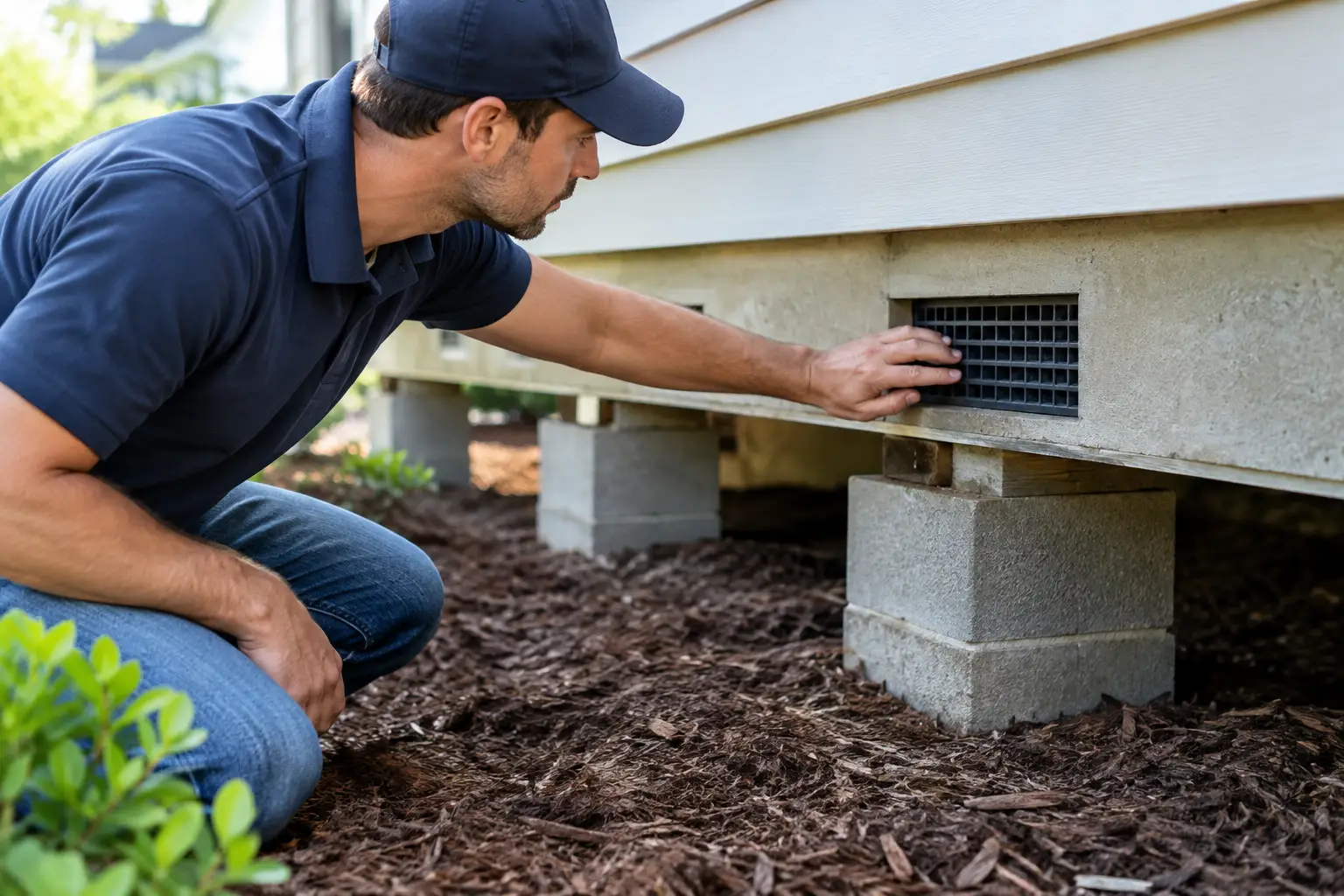
A crawlspace can look dry from the access opening and still be holding enough moisture to support fungal growth, attract wood-destroying insects, and damage framing over time. Knowing how to maintain pier ventilation means looking beyond the vent covers themselves. The goal is to manage the moisture beneath the structure while keeping the pier-and-beam foundation accessible, protected, and properly supported.
In Southeast Texas, that work deserves regular attention. Our long humid seasons, heavy rainfall, high water tables in some areas, and termite activity can turn a minor drainage or ventilation issue into a costly repair if it is left uncorrected.
What pier ventilation is supposed to do
A conventional pier-and-beam home has an open or partially enclosed crawlspace below the finished floor. Foundation vents allow air to move through that space, helping release moisture that can otherwise collect beneath the home. When the vents are open and unobstructed, the crawlspace is less likely to remain stagnant after rain or plumbing condensation.
Ventilation is only one part of moisture control. A vent cannot overcome standing water, leaking supply lines, disconnected drain piping, or soil that slopes toward the foundation. It also cannot correct a crawlspace that has been closed off by landscaping, additions, stored materials, or improperly installed skirting.
There is an important exception: some homes use a deliberately sealed and conditioned crawlspace design. Those systems are not maintained like a traditionally vented pier-and-beam foundation. If insulation, a vapor barrier, mechanical conditioning, or sealed vents indicate that the crawlspace was designed as an enclosed system, do not simply open vents or remove materials without understanding the full design. Changing one part of a moisture-control system can create a new problem.
Start with the exterior drainage conditions
The condition around the perimeter often tells the story beneath the house. Water should move away from the foundation, not collect beside it. During an inspection, wet soil, erosion at discharge points, low areas near the skirting, and downspouts that empty at the foundation are all conditions that deserve attention.
Keep gutters clear and extend downspout discharge away from the crawlspace perimeter. Repair leaking gutters and roof runoff problems promptly. In the Lumberton, Beaumont, and Orange areas, a hard rain can put a significant volume of water next to a home in a short period. If that water reaches the crawlspace repeatedly, ventilation alone will not keep the wood framing dry.
Also examine landscaping. Mulch, soil, flower beds, shrubs, and decorative rock should not block vents. Grade should generally remain below the bottom of wood siding and should not be built up against skirting. Besides restricting airflow, high soil levels can create concealed termite entry routes and increase the chance of moisture reaching wood components.
Keep foundation vents open, intact, and clear
Walk the perimeter at least twice a year and after major storms. Each vent opening should be visible, reasonably intact, and free of leaves, soil, insulation, animal nesting material, and stored belongings. A vent cover with fine metal screening can discourage animals while still allowing air movement, but it should not be painted shut, crushed, or packed with debris.
Do not cover vents with plastic, foam, or insulation as a quick attempt to solve cold floors or high humidity. In a conventional vented crawlspace, that can reduce needed air movement and trap moisture. If energy loss or comfort is the concern, the proper solution may involve evaluating floor insulation, duct leakage, air sealing above the crawlspace, or a professionally designed conditioned-crawlspace approach.
Pay close attention to vents near decks, porches, additions, and HVAC equipment. These are common locations for restricted airflow because later construction may have been installed too close to the foundation. The problem may not be obvious from one side of the house, which is why a complete perimeter review matters.
Check the crawlspace after rain, not only on dry days
A dry-weather inspection has limits. The most useful time to evaluate a crawlspace is after sustained rain, when drainage defects, groundwater intrusion, and plumbing leaks are easier to identify. Look for standing water, muddy soil, water staining on piers, wet insulation, dripping ductwork, or moisture on the underside of subflooring.
A musty odor at the access opening is also a warning sign. It does not identify the source by itself, but it indicates that the area needs a closer evaluation. Wood may show dark staining, fungal growth, softened areas, or visible decay where moisture has remained elevated for an extended period.
If water is present, determine where it is coming from before adding fans or additional vents. Common sources include poor surface drainage, a broken water line, a leaking drain line, overflowing air-conditioner condensate, groundwater, and plumbing fixtures above. Correcting the source is more effective than treating the symptom.
Maintain the ground cover and insulation correctly
A ground vapor barrier can reduce moisture evaporating from exposed soil. In a traditional crawlspace, it is commonly installed over the ground, with seams overlapped and the material kept reasonably flat. It should not block vent openings or cover foundation components in a way that prevents observation of moisture, pest activity, or structural movement.
Torn, displaced, or heavily contaminated vapor barrier material should be repaired or replaced. A barrier lying in standing water, however, is not the real issue. The drainage problem underneath it still needs correction.
Floor insulation should be supported against the underside of the floor system, not hanging down in strips or lying on wet soil. Falling insulation often indicates failed supports, animal disturbance, excess moisture, or all three. Wet insulation loses effectiveness and can conceal deteriorated framing. It should be evaluated along with the moisture conditions that caused it to fail.
Do not overlook termites and other pests
A warm, damp crawlspace is favorable to termites, carpenter ants, wood-decaying fungi, and other pests. Termites do not require visible standing water, but persistent moisture makes wood more vulnerable and can increase the likelihood of conditions that support infestation.
During routine checks, look for mud tubes on piers, foundation walls, plumbing penetrations, and wood framing. Also watch for damaged vent screens, rodent droppings, chewed insulation, or animal nesting. These signs do not replace a professional wood-destroying insect evaluation, but they are good reasons to schedule one.
Do not use stored lumber, cardboard, firewood, or construction debris under the home. Wood debris can retain moisture and provide a concealed pest harborage area. Keep the crawlspace accessible for inspection and repair instead of using it as long-term storage.
When adding ventilation can make conditions worse
More ventilation is not always better in a humid climate. During much of the year, outside air in Southeast Texas carries substantial moisture. When humid air enters a cooler crawlspace, it can condense on ducts, pipes, and framing. This is one reason a crawlspace should be evaluated as a complete system rather than treated by adding random vents or fans.
Mechanical fans may be appropriate in specific situations, but they should be selected and installed based on the actual moisture source and the crawlspace design. An improperly placed fan can pull humid outdoor air into the space or create pressure conditions that affect indoor air quality. Likewise, sealing vents without proper ground moisture control, insulation strategy, and conditioning can trap moisture below the home.
If the crawlspace repeatedly tests damp despite clear vents and functional drainage, a qualified inspection can help identify whether the property needs drainage correction, plumbing repair, a vapor barrier upgrade, dehumidification, or a redesigned enclosed-crawlspace system.
A practical inspection schedule
Most homeowners can make pier ventilation maintenance part of seasonal exterior care. Check the perimeter and vent openings in spring, again before the wettest part of the year, and after any major storm or plumbing leak. Review the crawlspace whenever you notice sagging floors, new musty odors, unusually high indoor humidity, insect activity, or unexplained changes in flooring.
Some conditions require prompt professional attention: standing water that does not drain, visible decay, damaged or shifted piers, active termite evidence, leaking plumbing, disconnected ducts, or significant fungal growth. These are not cosmetic defects. They can affect structural performance, indoor conditions, and the long-term cost of ownership.
A well-maintained crawlspace is rarely the result of one repair. It comes from clear vents, controlled roof runoff, sound drainage, dry plumbing, intact ground cover, and regular observation. When those basic conditions are maintained, the area beneath the home remains easier to inspect and far less likely to hide a developing moisture problem.
